Industrial workplaces often require employees to handle heavy tools and equipment throughout the day. Repeatedly lifting, holding, and repositioning these tools can cause fatigue and slow down routine operations. Using suitable tool-support equipment can make these tasks easier and help maintain an organised workstation. Tool balancers and beam trolleys are useful solutions for industries where equipment needs to remain accessible and move between different working positions.
These products are commonly used in automotive manufacturing, welding shops, assembly lines, and production facilities. They support suspended tools and help workers manage repetitive tasks with less physical effort.
How Do Tool Balancers and Beam Trolleys Work?
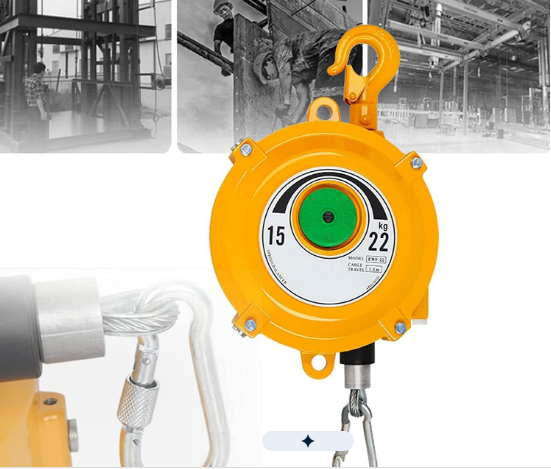
Tool balancers use an internal spring mechanism to counterbalance the weight of suspended equipment. A tool is attached to a wire rope, and the spring tension helps support its weight. Workers can pull the tool down when required and guide it back after completing the task. This arrangement keeps frequently used equipment within easy reach. It also reduces the need for workers to continuously hold the full weight of a tool. Different models are available for various load capacities and cable travel requirements.
Beam trolleys serve a different but complementary purpose. They move along an overhead I-beam and carry suspended equipment across a workstation. When a spring balancer is attached to a compatible trolley, the combination allows both vertical tool movement and horizontal travel.
For example, an operator working on an automotive assembly line can move a suspended pneumatic tool along the beam and position it wherever needed. This can reduce unnecessary movement and make repetitive operations more convenient.
Important Features to Consider
Before selecting industrial tool-support equipment, businesses should understand the features that influence performance and safety.
- Load capacity: The equipment must support the actual weight of the suspended tool and attachments.
- Cable travel: Sufficient travel allows workers to reach the required working positions.
- Spring adjustment: Suitable adjustment helps maintain the correct balance for different tool weights.
- Safety components: Lock pins, secondary support points, and enclosed spring assemblies can improve workplace protection.
- Durable construction: Strong materials and suitable components support regular industrial use.
The correct combination of tool balancers and beam trolleys depends on the application, suspended load, mounting arrangement, and available workspace. Checking manufacturer specifications before installation is essential.
Applications in Manufacturing and Assembly Operations
Industrial tool-support systems are useful in several working environments. Automotive plants use them to support pneumatic tools and equipment during vehicle assembly. Welding stations can use suitable balancers to suspend welding guns, while general manufacturing facilities may use them for repetitive fastening and production tasks. They can also help improve workstation organisation by keeping tools off the floor and reducing clutter around operators. However, regular inspection remains necessary. Workers should check cables, hooks, trolley rollers, mounting points, and safety components according to the manufacturer’s recommendations.
Never exceed the rated capacity or use damaged equipment. Correct installation and routine maintenance help maintain reliable performance over time.
Conclusion
Industrial tool-support equipment helps make repetitive operations more manageable while keeping tools accessible. Choosing compatible balancers and trolleys can improve workplace organisation and operator convenience. Spring Balancers offers industrial spring balancers and specially designed I-beam trolleys for different applications. Explore its product range for practical equipment-support solutions across manufacturing facilities, welding shops, and assembly lines.