
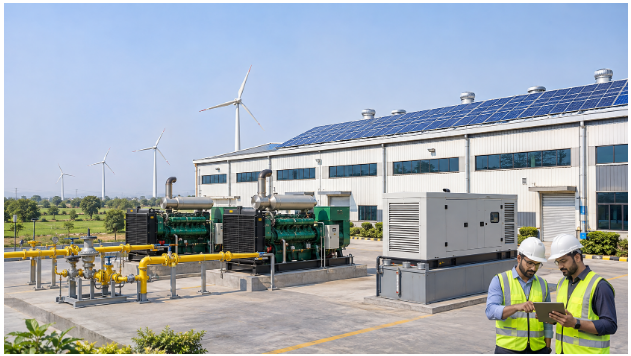
A factory can have enough installed generation capacity and still face expensive power or interruptions to production. The problem often lies in when that capacity is available, what it costs to operate and how the different sources work together.
Solar produces during daylight. Wind follows local weather conditions. Gas engines can supply electricity when required, provided fuel is available. Diesel generators can cover outages and emergencies.
Building the right energy mix means assigning each source a useful job. A textile mill operating three shifts will need a different arrangement from a warehouse that closes before sunset.
What Does Captive Power Mean?
Captive power is electricity generated primarily for a business’s own consumption. It can come from engines, solar panels, wind turbines or a combination of these.
A captive installation can also remain connected to the utility grid. Generating electricity on site does not necessarily mean disconnecting from the network.
For an industrial user, the main questions are practical: how much electricity can be produced at an acceptable cost, and what will keep essential equipment running when one source becomes unavailable?
Start With the Factory’s Demand
The electricity bill shows how much energy a business buys. It does not fully explain how that energy is used.
Before selecting equipment, record demand throughout production shifts, overnight periods and shutdown days. Review at least a representative year of bills and operating records, supported by interval measurements where available.
The assessment should establish:
- Average and peak electrical demand.
- Loads that must remain supplied during an outage.
- Motor starting requirements and sudden load changes.
- Overnight and weekend consumption.
- Existing generator fuel use and operating hours.
- Process requirements for steam, hot water or cooling.
Consider an illustrative factory drawing 1 MW for 16 hours and 300 kW for the remaining eight hours. Its daily electricity requirement is 18.4 MWh.
Installing 1 MW of solar does not mean this demand is covered. Solar capacity describes rated output under specified conditions. Actual generation changes through the day and stops after sunset.
That difference between power capacity and energy delivered should guide every equipment decision.
The Role of Solar in Captive Power
Solar is worth assessing where a business has usable roof or land area and substantial daytime consumption.
Electricity produced while machinery is running can reduce purchases from the grid or generation from engines. The financial value depends on which source solar replaces at that moment.
A factory running six days a week may use a high share of its solar production directly. A site that closes frequently may have more surplus generation, depending on its operating schedule and available storage or export arrangements.
A proper assessment of industrial solar energy should therefore consider shading, roof condition, available space and the timing of demand.
It should also account for periods when solar output must be restricted because the site cannot use, store or export it. The largest array that fits on the roof is not automatically the most economical choice.
Where Wind Fits in Pakistan
Wind deserves attention where the local resource and project scale support it.
The World Bank’s renewable energy locational study identifies strong solar and wind resources in Sindh, including opportunities around Jhimpir and Gharo. These regional findings provide a starting point for investigation rather than proof that any particular factory site is suitable. Source: World Bank, Variable Renewable Energy Locational Study, Annex 4
A captive wind power project needs an assessment of wind conditions at the proposed turbine height, terrain, access, foundations and electrical connection. The U.S. Department of Energy also distinguishes broad wind resource maps from the detailed assessment needed for a specific location. Source: U.S. Department of Energy, Wind Maps and Data
Wind can produce after sunset, but its contribution must be checked against hourly and seasonal demand. It should not be assumed to cover every night or consistently increase whenever solar output falls.
The useful question is how much wind generation would reduce fuel consumption or grid purchases at this site, after allowing for losses and periods of surplus output.
Gas Power Requires a Fresh Cost Calculation
Gas engines offer controllable generation. They can supply demand that solar and wind cannot meet, subject to fuel availability, equipment capability and operating limits.
However, gas should not be treated as the cheapest option simply because it served that role in an earlier feasibility study.
Pakistan’s Off the Grid (Captive Power Plants) Levy Act, 2025 established a levy framework for natural gas and RLNG based captive generation. Project calculations need to include current applicable charges alongside the base fuel price. Sources: Pakistan Code and National Assembly, Off the Grid (Captive Power Plants) Levy Bill as passed by Parliament
When assessing gas power systems, examine fuel consumption at the expected operating loads, maintenance expenses, gas pressure and supply terms.
Include the Value of Useful Heat
A gas engine can also supply recoverable heat for suitable industrial processes. Combined heat and power equipment produces electricity while capturing heat that would otherwise be rejected. Source: INNIO Jenbacher, Cogeneration and Combined Heat and Power
This matters when adding renewables to an existing plant.
If solar reduces gas engine output, the factory may receive less recovered heat. A boiler might then need additional fuel to maintain steam or hot water production.
The cost comparison should include that replacement heat. Similarly, keeping an engine running mainly for heat may limit how much solar electricity the site can accept.
Electricity and thermal demand need to be assessed together.
Give Diesel a Defined Backup Role
Diesel generation can remain useful for emergencies, gas supply interruptions or periods when other sources cannot meet demand.
Its role should be clear. A generator reserved for occasional outages is being evaluated for a different duty from one supplying production throughout the day.
Compare actual fuel consumption at the expected load, service requirements, fuel storage and the cost of keeping the unit available.
Renewables may reduce diesel consumption while the engine continues running. Removing engine hours requires enough alternative supply, suitable controls and equipment capable of maintaining the local electrical network with the generator switched off.
Avoid assuming that a reduction in generator output will produce the same percentage reduction in fuel consumption.
Batteries and Controls Connect the Sources
Batteries store electricity for later use. They can help cover shortfalls, reduce generator starts and support selected loads through an interruption.
Their value depends on both power and duration.
For example, supplying a steady 300 kW load for four hours requires 1.2 MWh of delivered energy. Battery nameplate capacity must also allow for conversion losses, operating reserves and the permitted discharge range.
The inverter must support the required power and any relevant starting loads. NREL’s microgrid design guidance highlights load characteristics, motor starting currents and reserve requirements when selecting generation equipment. Source: NREL, Microgrids for Energy Resilience
Controls determine how these assets operate together. A microgrid control system coordinates sources, manages power balance and applies the intended operating sequence.
The design must explain what happens when a generator trips, clouds reduce solar output, wind falls or the battery reaches its reserve level. Operation during a grid outage also requires suitable isolation, protection and a source capable of maintaining voltage and frequency.
Match the Arrangement to the Business
The following options are starting points for assessment, rather than fixed recommendations.
| Site operating pattern | Arrangement worth assessing | Main question to resolve |
|---|---|---|
| Factory with high daytime demand | Solar with existing grid or engine supply | How much solar output can production use directly? |
| Factory with steady electrical and thermal demand | Gas CHP with carefully sized solar | What happens to heat supply when engine output falls? |
| Facility at a suitable wind location | Wind and solar with controllable backup | How do both resources match demand across the year? |
| Warehouse with modest overnight demand | Solar with batteries for selected loads | Which loads justify storage, and for how long? |
| Site exposed to prolonged supply interruptions | Multiple sources with adequate reserve | Can essential production continue after a source fails? |
A useful study should compare several configurations. Including all four generation sources is justified only when each makes a measurable contribution.
Compare the Total Cost of Supplying the Load
A low generation cost from one source does not establish the cost of the whole installation.
Include equipment, civil works, electrical connections, controls, maintenance, fuel, applicable levies, financing and expected replacements.
For batteries, account for charging losses and capacity degradation. For wind, include access and maintenance arrangements. For engines, use fuel consumption at the loads the proposed system will actually require.
Also retain any grid charges that remain payable under the site’s connection and tariff.
Assess alternatives over the same period and against the same production assumptions. Avoid counting one unit of renewable electricity twice, once as avoided diesel generation and again as an avoided grid purchase.
Then test how the result changes if fuel costs rise, output is lower than expected, production shifts change or equipment needs maintenance.
Build in Stages Where the Evidence Supports It
An existing power plant does not always need to be replaced at once.
A business can begin with metering and improvements to operating schedules, then add equipment where the demand records support the investment. Later additions should reflect measured performance and any changes in production.
Before accepting a proposal, ask for expected annual generation, fuel consumption, generator hours, restricted renewable output and the conditions under which demand could remain unmet.
These figures make competing designs easier to compare than equipment capacity alone.
Orient Energy Systems provides solar, wind, gas, diesel, storage and microgrid services. Reviewing these together allows the proposed equipment and operating arrangements to be considered as one power supply system. Source: Orient Energy Systems
The right captive power mix starts with the factory’s working hours, production needs and available resources. Those records establish what each source can contribute and how much backup the business still needs.