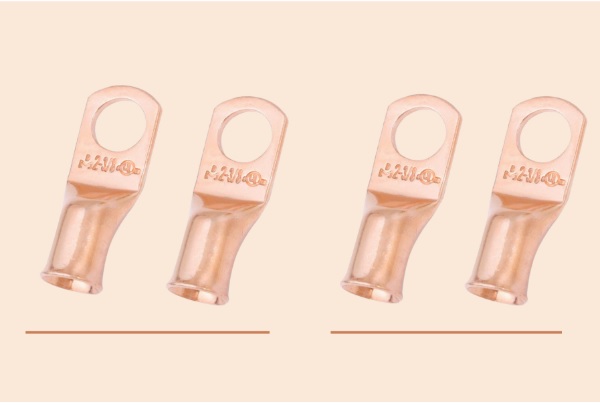
Copper battery lugs are solid parts when done right. They handle high current, stay cool, and last for years. But even the best copper battery lug can fail fast if it’s installed wrong. A bad install leads to heat, loose connections, corrosion, and early replacement.
Most people don’t notice these mistakes until the lug overheats, the cable pulls out, or the whole system starts acting up. This is a list of common installation mistakes that kill copper battery lugs and heavy duty wire lugs way too early.
Mistake 1: Using the Wrong Lug Size for the Cable
This is the number one mistake. If the lug doesn’t match the cable gauge, nothing else matters.
If the lug is too small for the cable:
- The cable can’t fit in the barrel
- You end up forcing it, damaging strands
- The connection overheats and fails
If the lug is too big:
- The cable doesn’t fill the barrel
- The crimp is loose and weak
- Current flows unevenly, causing heat and voltage drop
For copper battery lugs, the lug must match the wire size. If it’s 4 AWG cable, use a 4 AWG lug. If it’s 2/0, use 2/0. No shortcuts.
Heavy duty wire lugs are built for specific sizes. Check the marking on the lug. If it says 4 AWG, don’t use it on 6 AWG or 2 AWG.
Mistake 2: Wrong Crimping Tool or Technique
A lot of consumers use pliers, vice grips, or low-quality ratchet crimpers which is not advisable
Pliers can’t make a proper gas‑tight crimp. They squeeze unevenly, leave gaps, and don’t compress the copper properly.
What happens:
- The connection isn’t mechanically strong
- Cable strands can pull out
- Resistance increases, causing heat
The right way:
- Use a proper crimping tool for copper lugs
- Pick the right die for the lug size
- Make one solid crimp in the middle of the barrel
- Check that the lug is tight and the cable can’t be pulled out by hand
For heavy duty wire lugs, a single, proper crimp is usually enough. If the lug is long or for very high current, some people do two crimps. But always use the right tool.
Mistake 3: Not Inserting Cable Strands Fully
This is so common it’s frustrating. You strip the cable, put half the strands in the barrel, and crimp. That’s a failure waiting to happen.
What goes wrong:
- Loose strands outside the barrel get hot
- Current flows through the loose strands, not the crimp
- The connection burns, melts, or arcs
The fix:
- Measure the right length (usually 1/2 to 3/4 inch)
- Insert all strands fully into the barrel
- The insulation should touch the back of the lug
- No strands left outside
If the lug has an inspection hole, use it to check. If you can see insulation at the back, it’s done right.
Mistake 4: Skipping Heat Shrink or Insulation
A crimped copper battery lug with no protection is asking for trouble. Moisture, dirt, salt, and vibration will eat it alive.
Bare crimps lead to:
- Corrosion inside the crimp
- Short circuits to nearby metal
- Mechanical damage from rubbing or vibration
Always:
- Slide heat shrink tubing over the cable before crimping
- Position it to cover the entire lug and 1 inch of cable
- Shrink it with a heat gun until tight
For heavy duty wire lugs in boats, RVs, or outdoor setups, use adhesive‑lined heat shrink. The glue melts and seals against water.
Mistake 5: Over or Under‑Tightening the Terminal Nut
After crimping, you bolt the lug to the battery terminal or stud. Getting this wrong is common.
If you under‑tighten:
- The lug moves on the stud
- Arcing and heat build up
- The connection loosens over time
If you over‑tighten:
- You strip the stud
- You crush the lug or terminal
- The lug can crack or deform
The right way:
- Clean the stud first
- Use a lock washer if the setup has one
- Finger tight, then quarter to half turn with a wrench
- If you know the torque spec, use it
Mistake 6: Using Bare Copper in Wet or Salty Environments
Bare copper battery lugs are great for dry, clean indoor setups. But in boats, RVs, solar, or coastal areas, bare copper corrodes fast.
What happens:
- Green oxidation builds up
- Resistance increases
- Connections get hot and unreliable
If the environment is damp, salty, or outdoor, use tinned copper battery lugs instead. The tin coating slows corrosion and keeps the surface cleaner.
Heavy duty wire lugs for marine or outdoor use should be tinned.
Mistake 7: Quality Checks
Before crimping, it’s important to do the necessary checks.
If strands are:
- Broken or cut
- Twisted outside the barrel
- Not filling the barrel evenly
The crimp will be weak, and current will concentrate in the good strands, causing heat.
Always:
- Inspect the stripped end
- Make sure strands are straight and undamaged
If the cable is damaged, cut back and redo the process.
Mistake 8: Ignoring Vibration and Movement
In engines, boats, RVs, and solar setups, vibration is consistent. It tends to loosen connections, even if they start off well.
To fight vibration:
- Use a proper crimp
- Use lock washers on studs
- Add heat shrink for strain relief
- Check connections regularly (every 3–6 months)
Loose lugs are a common cause of intermittent power loss.
Mistake 9: Overlooking the Stud Size Match
The lug hole must match the stud size. A loose fit or tight fit causes problems.
Loose lug hole:
- Lug wobbles on the stud
- Arcing and heat
- Loose connection over time
Tight lug hole:
- Can’t get it on
- Force it, and you damage the lug or stud
Measure the stud. Pick copper battery lugs with the matching hole size (1/4″, 5/16″, 3/8″, etc.).
Mistake 10: Improper Storage and Handling
Copper battery lugs corrode if left in damp places or mixed with different metals.
To avoid:
- Store lugs in a dry container
- Keep them separate from steel or aluminum
- Use them soon after buying if possible
Oxidized lugs don’t crimp well and won’t make good connections.
Final Thoughts
Heavy duty wire lugs are built to last. But bad installation kills them fast.
The most common problems:
- Wrong lug size
- Bad crimping tool
- Cable not fully inserted
- No heat shrink protection
- Loose or over‑tight nuts
Do it right:
- Match lug size to cable
- Use proper tools
- Insert cable fully
- Add heat shrink
- Tighten correctly
A good copper battery lug installation will last years without issues.